



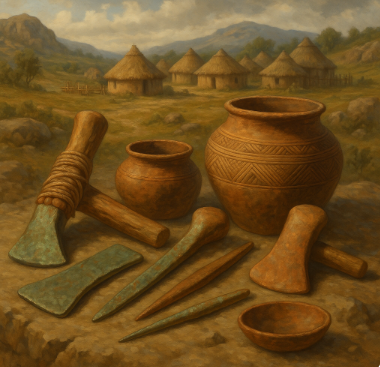
The Copper Age Quiz
Explore the Chalcolithic Copper Age, when humans first mastered metalworking. Test your knowledge of early tools, cultures, and this pivotal era in history.



The Chalcolithic Copper Age: Humanity’s First Steps into Metalworking
Introduction
The Chalcolithic period, also known as the Copper Age, marks a crucial stage in human history when societies first learned to work with metal. Occurring roughly between 4500 BCE and 3300 BCE in parts of the Near East, Europe, and South Asia, this era bridged the gap between the Neolithic Stone Age and the Bronze Age. The discovery and use of copper transformed tools, weapons, and cultural practices, setting humanity on a new technological path. The Copper Age was more than a shift in materials—it was a revolution in society, trade, and innovation.
From Stone to Metal
For thousands of years, human beings relied primarily on stone tools. The transition to copper was groundbreaking. Early experiments with native copper, found in a malleable state in nature, allowed communities to hammer it into simple tools and ornaments. Unlike stone, copper could be shaped, sharpened, and reused, giving it distinct advantages.
At first, copper tools coexisted with stone implements, but over time, the durability and versatility of metal began to reshape everyday life. The Chalcolithic did not entirely replace stone but introduced the first step toward metallurgy that would later define the Bronze Age.
Cultural and Technological Advances
The Chalcolithic was not only about metal; it was a period of remarkable cultural development. Settlements grew larger, with some evolving into proto-urban centers. Advances in agriculture, animal husbandry, and pottery accompanied the use of copper, reflecting increasingly complex societies.
Trade networks expanded dramatically during this period, as copper ore was not evenly distributed across regions. Communities without local sources relied on long-distance trade to acquire the valuable metal. This exchange connected cultures from the Balkans to Mesopotamia, spreading not only materials but also ideas and innovations.
Burial practices also grew more elaborate. Copper ornaments, tools, and weapons were often placed in graves, signifying status and wealth. The emergence of social hierarchies became more visible, with metal playing a symbolic role in demonstrating power and prestige.
Regional Variations
The Copper Age unfolded differently across the world:
-
Balkans and Eastern Europe: Some of the earliest evidence of copper smelting comes from this region, with sites like Varna in Bulgaria, famous for its gold and copper grave goods.
-
Mesopotamia and the Near East: Here, metallurgy advanced rapidly, laying the foundations for Bronze Age civilizations.
-
South Asia: The Chalcolithic cultures of the Indus Valley began experimenting with copper, blending it with traditional tools and pottery.
-
Iberian Peninsula: Copper mining and metallurgy flourished, with distinct cultural styles that spread across Western Europe.
These regional differences highlight how the Chalcolithic was not a uniform era but a mosaic of interconnected yet diverse cultures.
Legacy of the Copper Age
The Chalcolithic Copper Age was a turning point in human history. While later overshadowed by the Bronze Age, its innovations created the foundation for advanced metallurgy. More importantly, the era demonstrated humanity’s ability to adapt, experiment, and harness natural resources in new ways.
By introducing metal tools and weapons, societies could farm more efficiently, build more durable structures, and wage more effective wars. The social and cultural changes—trade networks, hierarchical societies, and symbolic use of metal—would shape civilizations for millennia.
Conclusion
The Chalcolithic Copper Age was more than a transitional period; it was a revolution in how humans lived, worked, and connected. From hammered copper tools to expansive trade routes, this era marked the dawn of metallurgy and set the stage for the great civilizations of the Bronze Age. By exploring the Copper Age, we uncover the roots of technology and society as we know them today—a reminder that humanity’s first steps into metal were also steps into the modern world.
Download our App Now!
Join the ranks of true trivia champions and quench your thirst for knowledge with Masters of Trivia – the ultimate quiz app designed to test your wits and unlock a world of fun facts.
Challenge your brain, compete with friends, and discover fascinating tidbits from diverse categories. Don't miss out on the exhilarating experience that awaits you – get started now!